Dear RoboCupJunior Rescue Simulation Committee,
I hope this message finds you well.
We are currently in the final stages of our preparation for RoboCupJunior Rescue Simulation 2026, and we have encountered an issue regarding the mapping system that we would greatly appreciate your clarification on.
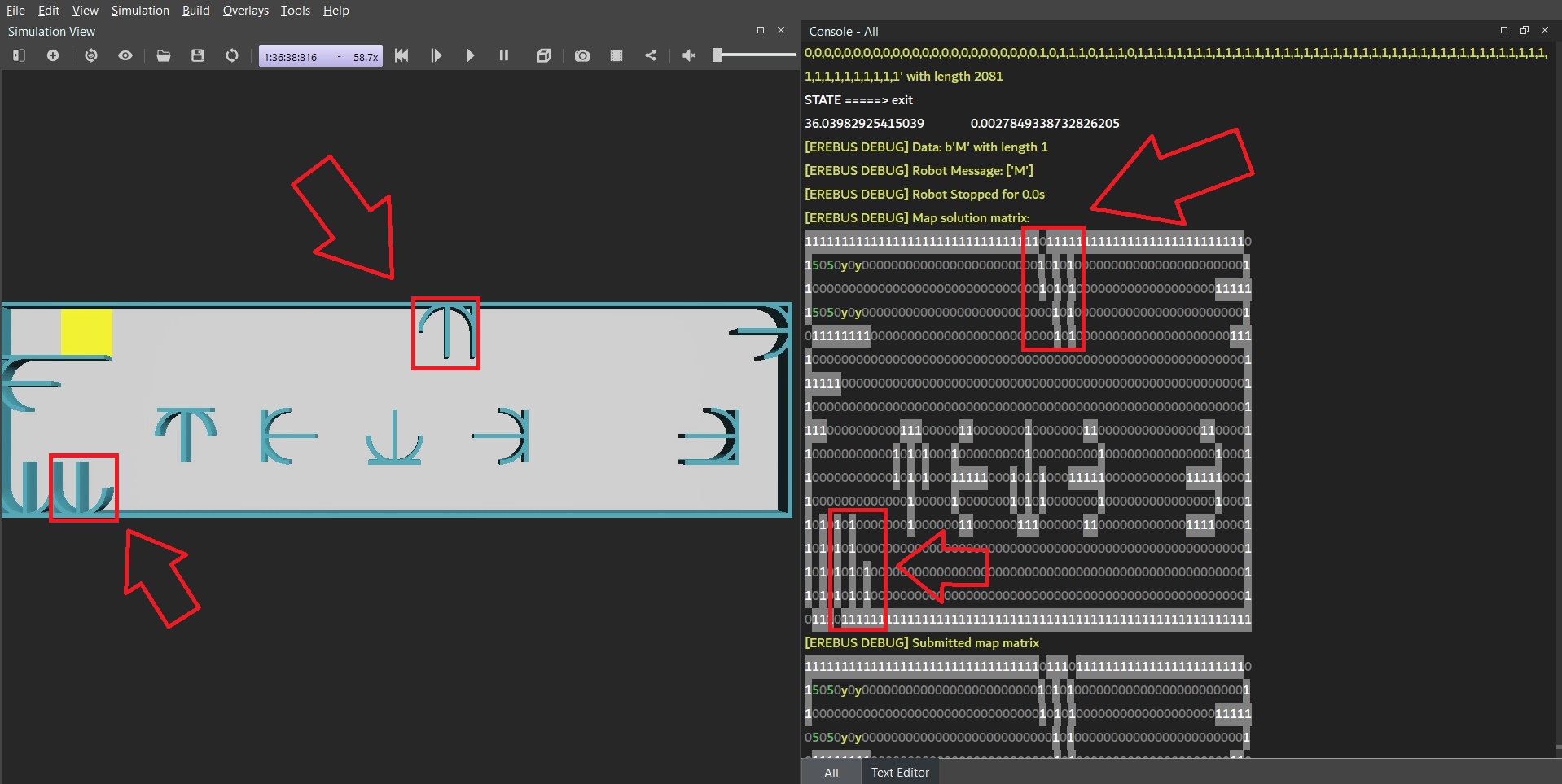
As shown in the attached image, the solution matrix appears to represent the vertex of a curved wall with a value of 1. However, according to the official rules (Section 5.6, Scoring → Mapping Bonus → b.iv.), it is stated that the vertex corresponding to curved walls in Area 3 should be represented by ‘0’ in the submitted map.
This discrepancy has led to some confusion on our side, especially since we have encountered similar situations multiple times during our testing.
We would like to kindly ask for clarification on the following:
Is the representation shown in the solution matrix intended and correct?
If so, could you please elaborate on how curved wall vertices are internally handled or discretized in the official evaluation system? (In which cases we need to
put “1” instead of “0” for the curved wall vertex?)
We truly appreciate your time and effort in supporting teams and ensuring clarity in the competition rules.
Thank you very much for your attention.
Kind regards,