Hello @Alex98
Thank you for publishing the 2027 RCJ Rescue Simulation Draft Rules.
I have listed below the points in the rules that I found unclear or had questions about while reading them. I would appreciate it if you could take another look at them.
(A) Summary
Area 4 (optional area) is not tile-based
Only Area 4 is described as an “optional area.” Could you please explain what “optional area” means in this context?
(B)
3.1.4.Teams are encouraged to develop their worlds
I assume that “world” refers to the course, but there is no other explanation of the term “world.” I think it would be easier to understand if the rules explained that “world” refers to the course.
(C)
3.3.7. Black holes will affect the determination of the tile type (linear or floating) since they can be considered virtual walls.
Only here is the term “Black holes” used. Elsewhere, the term “holes” is used. Using a different term here could cause confusion. I think it would be better to change it to “holes” to match the terminology used elsewhere.
(D)
3.6.3.e. The center of the obstacle will always be on a tile and not on the edge between them.
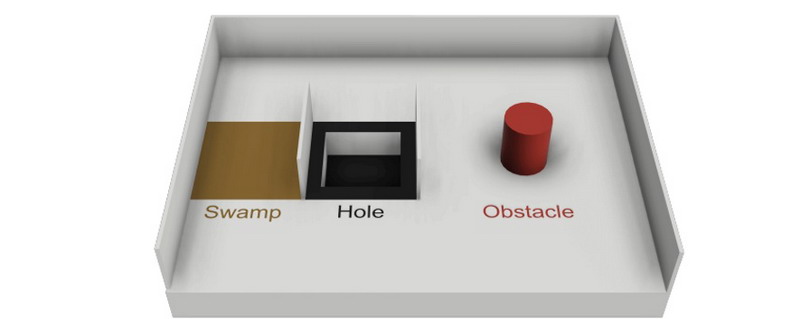
It states that the center of an obstacle should not be placed on a tile boundary. I understand that the center of an obstacle should not be on a boundary, but does this mean that an obstacle may be placed across multiple tiles?
Also, in the illustration below (the illustration under 3.6.4.b), the center of the obstacle appears to be placed on a tile boundary. Is this illustration not against the rules?
Please revise the illustration so that it complies with the rules.
(E)
3.8.2.However, they are not placed in the passages connecting areas.
I understand that Smiley victims are not placed in passages connecting areas. However, there are no conditions specified for where Cognitive targets can be placed. Does this mean that Cognitive targets can be placed anywhere on the course?
If there are any conditions regarding where they can be placed, please specify them clearly in the rules.
(F) the illustration below 3.8.9
The text in this illustration is too small to read. Please make it larger and clearer so that the text can be read easily.
(G)
3.8.10. Smiley victims signs can be rotated between -PI and PI radians (0 to 360 degrees) in the roll dimension.
If the range is from -PI to PI, I think the correct range should be -180 to 180 degrees, rather than 0 to 360 degrees.
(H)
5.2.3. No one is allowed to touch the simulation environments intentionally during a game.
I feel that this is partially inconsistent with Rule 5.2.2. Would it be better to revise it as follows?
→ No one other than the referee is allowed to intentionally interact with the simulation environment during a game.
(I)
5.3.5. No program changes or updates after each round’s deadline are allowed.
The term “deadline” is used in this section, but there is no explanation of what the “deadline” refers to. Could you please clarify what is meant by “deadline”? It would also be helpful if an explanation of “deadline” could be added to the rules.
(J)
5.6.5.c. The robot identifies a victim as a hazard or vice versa.
What does “hazard” refer to here? Is “hazard” a mistake, and should it be “Cognitive target” instead?
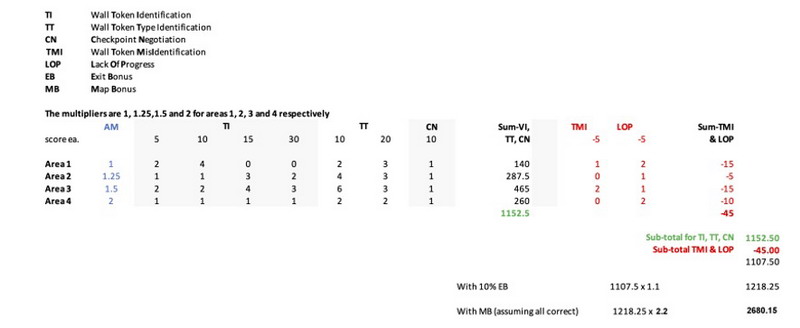
(K) The example in the scoring table below Rule 5.6.12
In this table, the TI scores for Area 4 should only be 15 points or 30 points. Therefore, it seems incorrect that the number “1” appears in the 5-point and 10-point columns. Since these scores are not possible, please correct this.
Also, I believe that “Sum VI” is incorrect and should be “Sum TI.”
Best regards,
MASA