Hello @Alex98
Thank you for publishing the 2027 RCJ Rescue Maze Draft Rules.
I have listed below the points in the rules that I found unclear or had questions about while reading them. I would appreciate it if you could take another look at them.
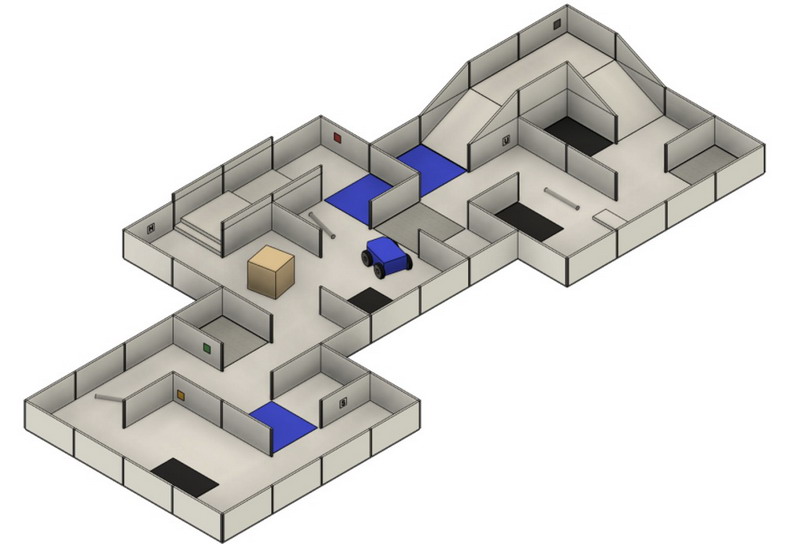
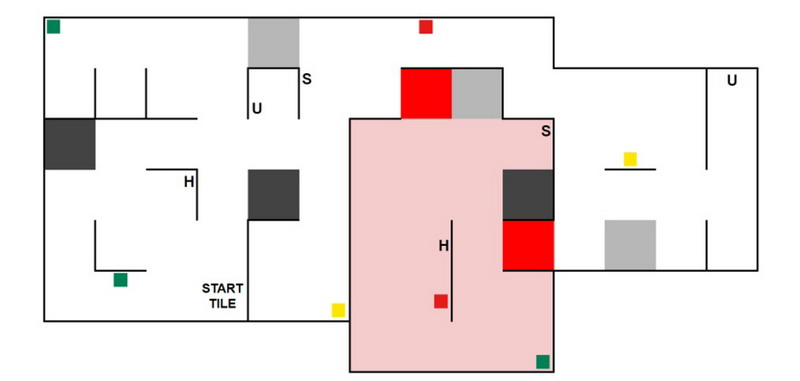
(A) the illustration of the entire field after the “Scenario” section
This illustration is not correct. The victims shown are based on the previous rules and do not match the 2027 rules. Please revise the illustration so that it complies with the 2027 rules.
(B)
3.1.2. A Tile is a space of 28 cm x 28 cm
Has the tile size been changed from 30 cm × 30 cm to 28 cm × 28 cm?
If so, this would contradict Rule 3.3.3, which states:
“the pathway between two opposite walls is 28 cm wide.”
I do not understand the reason for the change in the wording of Rule 3.1.2. Could you please clarify what this rule is intended to indicate?
If the tile size has not changed, I would like to ask you to state clearly that “the tile size is 30 cm × 30 cm.”
(C)
3.1.3. Walls used to create the maze shall be at least 12.5 cm high from any floor,
The wall height has been changed from 15 cm to 12.5 cm. Could you please explain the reason for changing it to 12.5 cm?
I think changing the wall height is a good idea, but 12.5 cm seems like an unusual value. If the wall height is going to be changed, I think it would be better to make it 10 cm instead. This would make the wall height the same as in Rescue Line, allowing the same wall components to be used for both competitions.
(D)
3.5.5. The debris is not fixed to the floor and has a maximum height of 1 cm inside the dangerous zone.
There is not enough information about Debris. I think it would be better to include a description of Debris similar to Rule 3.5.3 in Rescue Line.
(E) the illustration below Rule 3.5.8
The illustration explaining the Dangerous Zone is not correct. The victims shown are based on the previous rules and do not match the 2027 rules. Please revise the illustration so that it complies with the 2027 rules.
(F) 3.7. Rescue Kits
The statement about the maximum number of rescue kits that can be carried by the robot has been removed. Does this mean that there is no longer a limit on the number of rescue kits that the robot can carry?
(G)
5.3.7. Before a scoring run begins, the referee will roll a standard 6-sided dice or another method of randomization set by the organizers to determine the location of the black, blue, red and silver tiles.
This rule states that the locations of the red tiles are determined by rolling dice. However, I understand that the locations of the red tiles are determined by the course design, so I do not think their locations can be changed by rolling dice.
Could you please clarify whether the locations of the red tiles are also intended to be randomized?
(H)
5.6.1. To successfully identify a victim, the robot must stop within 15 cm of a victim and blink with the specific LED or Display
I think it would be clearer and more consistent to use the term “Identification Light,” as defined in Rule 4.2.11, instead of “specific LED or Display.”
(I)
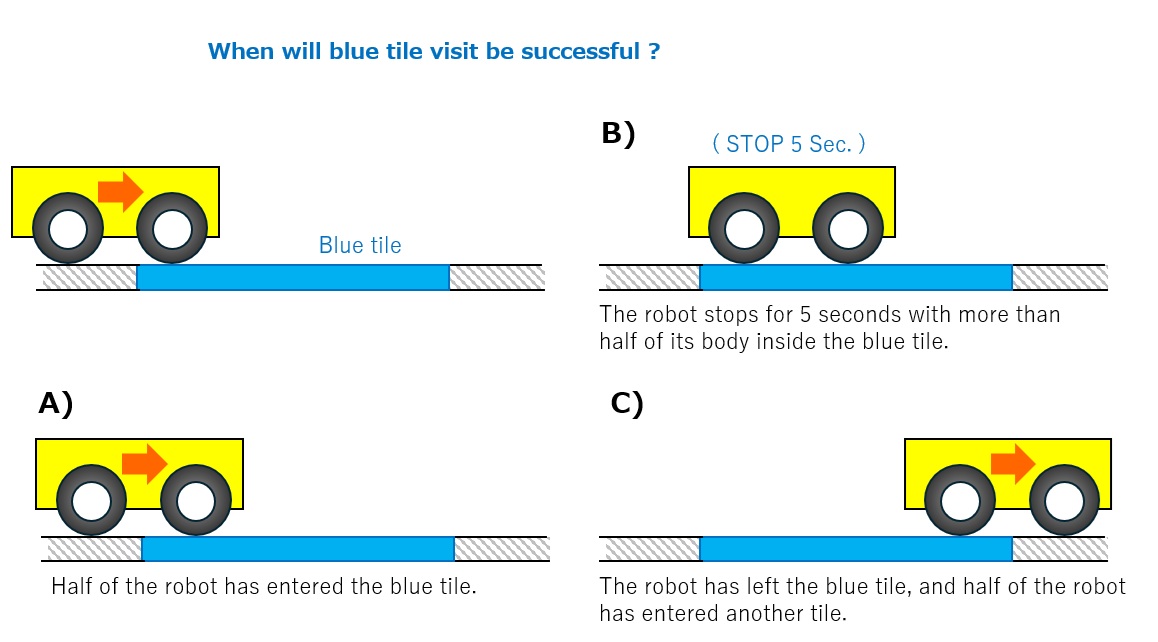
5.6.6. Successful blue tile visits (SBV). 30 points are awarded for visiting a blue tile once.
5.6.7 (RELIABILITY BONUS) = (SVI) × 10 + (SRD) × 10 + (SBV) × 10 − (LoP) × 15
Could you please clarify what value should be used for SBV?
Rule 5.6.6 seems to state that 30 points are awarded for a Successful Blue Tile Visit. However, if SBV = 30, then the calculation of the RELIABILITY BONUS in Rule 5.6.7 would add 30 × 10 = 300 points.
I believe that SBV refers to the number of blue tiles that are worth 30 points . .
Could you please clarify in Rule 5.6.6 what value SBV represents?
I would like the rules to be written clearly and unambiguously so that everyone can interpret and judge them in the same way.
Best regards,
MASA