I want to thank everyone who took the time to review the proposed changes that were previously shared in other forum posts, sharing their thoughts and proposing their ideas. Our goal as the RCJ Rescue Committee is to continue improving the leagues that we have, creating better learning opportunities for the competitors while looking for the next generation of innovations. Please review these draft rules and provide any feedback as soon as possible, as we will be releasing the final rules really soon.
Best,
Diego Garza Rodriguez on behalf of the 2026 RCJ Rescue Committee
Thank you for sharing the draft rules for Rescue Line 2026. I have a few concerns about the changes made to the previous rules and a few regarding the 2025 rules.
The evacuation zone is 120 cm by 90 cm with walls around the four sides at least 10 cm high and of any color (except for red, green, and black). The posts joining the walls of the evacuation zone can be of any color (except for red, green, and black).
Regarding the evacuation zone wall colors, could you please specify which colors may be used (excluding red, green, and black) so that teams can practice under realistic conditions?
The organizers may place white LED lights, mounted perpendicular to the wall, on the upper
part of the walls. They may not be placed in the corners where the triangles are located.
Since white LED lights may be placed on the walls, will these LEDs affect the readings of RGB/color sensors or camera-based vision systems? If so, how should teams account for this during detection?
The organizers may place fake victims (objects or images) that resemble real victims in the
evacuation zone. Robots should ignore them.
In the case of fake victims placed in the evacuation zone:
Will teams receive any points for correctly ignoring fake victims?
Will points be deducted if a fake victim is picked up and placed in the evacuation point?
If a robot picks up a victim, verifies it as fake, and then drops it, how will this be scored?
3.6. Intersections and Dead Ends
The organizers can place intersections anywhere except in the evacuation zone.
Intersection markers are green and 25 mm x 25 mm in dimension. They indicate the direction of the path the robot should follow.
The robot should continue straight ahead if there is no green marker at an intersection.
A dead end is when there are two green marks before an intersection (one on each side of the line); in this case, the robot should turn around.
The intersections are always perpendicular but may have 3 or 4 branches.
Intersection markers will be placed just before the intersection. See the images below for possible scenarios.
For intersections, the rules do not specify the minimum distance or gap between two consecutive intersections. Could you please clarify if there is a defined minimum spacing?
I expect that the most likely color organizer will use will be white (because they already have fields from last year) or gray (as the aluminum poles are commonly used for this piece of the field). Keep in mind that if an organizer wants to use bright orange it is within the rules and it is expected for the teams to be able to adapt to that.
That’s exactly the goal of the LED lights being added to the rules The goal is for teams to don’t depend on one type of sensor, implement their own lighting sources to minimize noise and have redundancy in mind for scenarios where one of the sensors is affected due this external lighting.
No points for ignoring a fake victim, no points deducted if a fake victim is picked nor if placed in the evacuation zone. The fake victims are added with the intention to slow down the teams if they don’t do a good job in differentiating a real vs a fake victim, but won’t have any points implications in the final score.
There is no minimum distance between two intersections. It could be possible to have an intersection right after another intersection by just leaving a small space between each green marker to make sure they don’t interfere with each other
I expect that the most likely color organizer will use will be white (because they already have fields from last year) or gray (as the aluminum poles are commonly used for this piece of the field). Keep in mind that if an organizer wants to use bright orange it is within the rules and it is expected for the teams to be able to adapt to that.
Just to clarify: if an organiser chooses a colour like orange, would that typically apply to just a specific section or wall, or should we prepare for the entire perimeter to be that colour?"
Thank you for sharing the draft rules.
I have read RCJRescueLine2026-draft.pdf, and I have some questions about it.
Section 4.1, which was included in the 2025 rules, has been removed. In particular, Section 4.1.5 described parts and modules that were not allowed to be used.
Does the removal of Section 4.1 mean that there are no longer any prohibited parts or modules (i.e., that any parts or modules may now be used)?
Are items such as line-following sensors, AI cameras, and OCR libraries, which were prohibited in Section 4.1.5 of the 2025 rules, now permitted for use in 2026?
I have read RCJRescueMaze2026-draft.pdf , and I have a question regarding the following section:
5.6.6. Successful blue tile visits (SBV). 30 points are awarded for visiting a blue tile once.
Does this mean that 30 points are awarded when the robot visits a blue tile — that is, when half of the robot enters the blue tile?
If the robot enters a blue tile and then passes through it without stopping, an LOP would occur, but since it visited the blue tile beforehand, would it still be awarded the 30 points?
I have read RCJRescueMaze2026-draft.pdf, and I have some questions regarding the following section:
5.6.12. Successful Exit Bonus. The ‘exit bonus’ condition is satisfied when the robot returns to the starting tile. On the starting tile, the robot has to blink (ON: 1s, OFF: 1s) with the same LED or display that is used to identify a victim (see Section 4.2, “Construction”) for at least 10 seconds.
Does the robot need to stop in order to receive the exit bonus?
Since Section 5.6.1 states that “the robot must stop,” it would be helpful if similar wording could be used here as well, as this would make judging easier for referees.
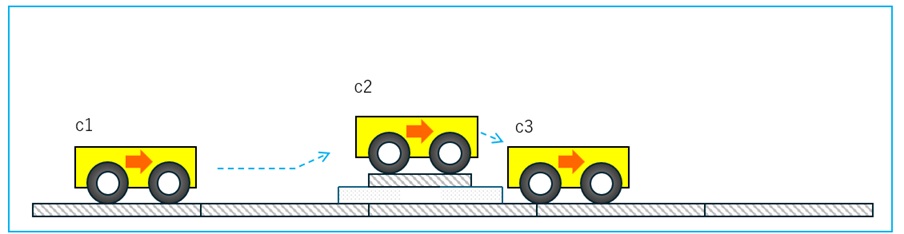
5.6.10 Successful navigation means the robot moves from the bottom to the top of the stairs (or vice-versa) and is entirely within the horizontal tile without toppling over.
As stated, the staircase points are awarded when the robot has completely entered the horizontal tile beyond the stairs.
If that is the case, the robot would not receive the staircase points unless it has completely entered that horizontal tile.
In the diagram below, even if the robot moves from c1 to c2, it would not receive the staircase points, because the robot is not entirely within the horizontal tile.
Thank you for reading the draft rules carefully and for your questions.
Even though the old “prohibited parts/modules list” (2025 section 4.1.5) is no longer present, that does not mean “everything is allowed” in 2026.
In the 2026 Rescue Line rules, the restrictions are written in a more general way. In particular, the rules still prohibit using commercially produced robot kits or sensor components that are specifically designed or marketed to complete any single primary task of RoboCupJunior Rescue (i.e., “task-solver” modules). This is intended to keep the league educational and fair.
What this means for your examples
Line-following sensors
If you mean a ready-made “line follower module” sold/marketed for line following / RCJ Rescue, then it is still not permitted under the “task-solver component” restriction.
If you mean general-purpose reflectance/IR sensors (that students integrate and program themselves), those are typically considered normal sensors and are generally acceptable.
AI cameras
A general camera / vision sensor can be fine.
But an “AI camera” module that is marketed as a complete line-following solution (or a complete rescue-task solution) would fall into the same “task-solver component” category and would not be permitted.
OCR libraries
The 2026 rules allow the use of external code, as long as teams credit the original creators and the team can explain what they are doing (i.e., it is not just using a complete solution without understanding).
So an OCR library is not automatically prohibited in 2026 by “parts/modules” rules. The key expectations are proper credit and student understanding.
It is very important that students understand it very well and are able to explain it.
Important practical note
Because these cases depend heavily on what exactly the item is and how it is marketed, the committee usually answers with this principle:
Generic sensors and tools are fine; “single-task RCJ Rescue solver” modules are not.
Best regards,
Mahmoud Madi
2026 RCJ Rescue Committee
 The goal is for teams to don’t depend on one type of sensor, implement their own lighting sources to minimize noise and have redundancy in mind for scenarios where one of the sensors is affected due this external lighting.