First, thank you all for the hard work that went into preparing the new rule draft.
My first comment concerns the tile dimensions. I recommend 29 cm instead of 28 cm , while retaining the proposed tolerances:
Nominal tile size
±10% range teams must accommodate
28 cm (current draft)
25.2–30.8 cm
29 cm (proposed)
26.1–31.9 cm
Rationale behind this recommendation:
It better fits the tiles hosts actually use. Standard square tiles are 30 cm in Europe and 12 inches (30.48 cm) elsewhere. Under the 28 cm draft, 12-inch tiles fall only 0.32 cm below the upper limit of 30.8 cm, so even a small variation in tile size or grout spacing could push a field out of tolerance. A 29 cm nominal size gives these common tiles a comfortable margin of more than 1.4 cm.
It gives robots the room the new rules require. Under the new rule draft, robots must carry dispensers for the larger rescue kits along with their cameras, and still clear 2 cm speed bumps and ramps. A smaller tile forces teams toward a smaller chassis at the same moment the rules are asking robots to carry more.
It offsets the steeper ramp. The draft raises the ramp incline from 25° to 30°. On a steeper slope, a robot needs a longer wheelbase and a low center of gravity to stay stable and avoid tipping. Shrinking the tile at the same time makes this considerably harder, especially for newer teams.
If the main goal is to simplify field construction for hosts, both options offer comparable flexibility. A 29 cm nominal size achieves that goal while also respecting the practical demands of robot design, giving hosts and teams a fairer balance.*
The current text, Rule 4.4.2.3, says obstacles “shall be at least 20 cm from any wall or touching any wall and at least 20 cm from the opposite edge of the tile and any other obstacle.”
This allows an obstacle to be placed so the only passage around it is<=20 cm wide. The draft doesn’t say whether such a passage is meant to be navigable.
Please clarify the intent and I would like to recommend the followings:
Option A – Navigable by design: Raise the minimum clearance to at least the maximum allowed robot width plus a margin, so every gap around an obstacle can be traversed.
Option B – Not guaranteed navigable: Keep 20 cm and add:
4.4.2.4 A gap between an obstacle and a wall, tile edge, or another obstacle that is narrower than 20cm is not guaranteed to be passable. Such a gap shall never be the only route to any scoring element or to the exit.
Beyond resolving the ambiguity, Option B also creates a valuable design trade-off.
The engineering trade-off it creates
Small chassis: Can take the shortcut, saving time. But there’s less room for sensors, batteries, and the rescue-kit mechanism, and a lighter robot may handle ramps and speed bumps worse.
Larger chassis: More capable and robust, but it must always take the long way, so it needs good mapping and path planning to stay competitive.
Neither choice is clearly better. That’s the kind of decision engineering competitions should reward. But, that’s a meaningful perception and planning problem, not just a hardware choice.
One might argue that a narrow gap that is the only route to a scoring item also creates a design trade-off!
No, It does not.
A trade-off requires at least two viable options. If the narrow gap is the only way to a scoring item, a robot that doesn’t fit has no alternative. It simply can’t score. That’s a entry requirement, not a choice - it’s like a locked door, not a fork in the road.
Think about the rationales: with an alternative route, instead of none.
**`. Giving up points with no alternative isn’t a trade-off between designs; it’s a penalty for size, set by the organizer’s layout and unknown until competition day. ** With a guaranteed alternative route, a large robot pays a time cost it can minimize through better navigation, which is a fair, engineering-driven trade-off.
**2. small and large designs remain viable, and the choice is part of learning value in engineering **
Teams can’t know in advance whether a competition field will place a scoring item behind a narrow-only path. The only safe design is to build small enough to fit. Once every rational team builds small, there’s no decision left, and robot designs converge instead of diversifying. With a guaranteed alternative route, both
3. A legal robot should be able to solve any legal field.
The robot rules and field rules together define the game. If a robot that fully complies with the size rules can be locked out of points by a field that fully complies with the placement rules, the two sets of rules contradict each other.
4. The outcome depends on the organizer, not the team.
The same robot could score everything on one field and be shut out on another, purely because of where the setup crew placed an obstacle. That makes results inconsistent across rounds and competitions, and it can’t be fixed by better engineering, only by building smaller “just in case.”
5. The educational value comes from weighing costs.
Students learn engineering judgment when they compare options: a faster shortcut versus a more capable robot. A forced constraint teaches only compliance with an unstated limit.
A 2 cm speed bump on a 30° ramp briefly increases the robot’s pitch by atan(2/wheelbase): e.g. about 6° for a 20 cm wheelbase… giving an effective 36° climb or descent. That concern links back to my 4.4.2.4 proposal .
Besides, placement of the speed bump matters greatly. Then, Tolerance makes it worse. All field measurements carry a ±10% tolerance. If that covers angles too, a “30°” ramp may be 33° and a “2 cm” bump 2.2 cm.
Right now we don’t have a problem with small robots being the best, if we feel that this is a problem we can always change the rules for it. A small robot still have the problem where it can’t carry as many kits and might have a harder time navigating stairs and speed bump.
We did not have problems with a lot of robots flipping over last year, so to make the hazard zone feel more hazardous we are deciding to try steeper ramps.
I feel like there is always tolerance in the real world, so either you can pass that ramp or speed bump should be up to your skill and not complaining about the tolerance. If it was 33 degrees instead of 30 and you can pass it because its 3 degrees off its a skill issue.
First of all, I would like to thank you for all the work you have put into revising the rules and for sharing the updated draft with the community. I truly appreciate your efforts to make the rules clearer and easier to understand.
After reviewing the new draft, my impression is that most of the changes primarily concern wording and structure, while the technical content remains largely unchanged. Although I certainly appreciate these improvements, several previously raised technical questions and ambiguities still appear to remain unresolved.
In this regard, I would like to raise two specific technical questions and draw your attention to some previously raised issues that remain open.
A. Tile dimensions and guaranteed clear pathway width
I would like to request clarification regarding the following provisions of the 2027 Rescue Maze rules.
4.1.2.
The tiles shall be of equal size, and be 28cm × 28cm.
4.1.3.
Walls shall be at least 12.5cm high measured from the field floor and shall be the length of the tile and be mounted on the edges of the tile.
3. Glossary – Tile
A square part of the field floor. The tile’s area is the navigable space by the robot.
My interpretation of these three provisions is that the 28 × 28 cm dimensions refer to the actual navigable area available to the robot, meaning that the thickness of the walls and their supporting structures should not reduce this area.
Otherwise, part of the nominally 28 × 28 cm tile would be occupied by the walls or their supporting structures, resulting in a smaller navigable area for the robot. This appears to contradict the definition provided in the glossary.
I would therefore like to ask the Committee to confirm whether this interpretation is correct and whether the 28 cm dimension refers to the clear distance between the inner surfaces of two opposite walls.
Furthermore, taking into account the ±10% dimensional tolerance specified in the rules, as well as the responses to recent forum discussions, I would like to ask one specific question:
What is the minimum permitted clear distance, expressed in centimetres, between the inner surfaces of two opposite walls located along the opposite edges of a tile?
I believe that clearly defining this minimum distance is particularly important for determining robot dimensions and ensuring consistent field construction.
B. The impact of different field dimensions on fair play and the regulation of robot size
In a previous forum discussion, it was mentioned that hosts of international competitions may have field tiles of different dimensions available to them, and that the rules should take this into account.
I understand the Committee’s previously expressed support for this consideration, as allowing organizers to use their existing field elements can be important from both an organizational and financial perspective.
However, I would like to highlight a potential consequence that may affect fairness and equal opportunities among teams.
If different field dimensions are permitted at international competition venues, teams qualifying in the host region may already be familiar with the exact physical dimensions of the locally used field elements during their preparations.
If those same field elements are subsequently used at the international competition, these teams may possess advance information that could give them an advantage when optimizing the physical dimensions of their robots.
Teams from other regions, on the other hand, may have to design their robots based on the most restrictive dimensions permitted by the rules.
In my opinion, to ensure fair play and equal opportunities, it would be worth considering two possible solutions:
Establishing uniform, actual navigable field dimensions for all international competition venues.
Clearly defining the maximum physical dimensions of robots.
Of these two options, I would consider the second more practical, as it would place fewer restrictions on host organizers while providing all teams with consistent and clearly defined design constraints in advance.
Community members have already proposed specific solutions in previous forum discussions, including defining a maximum diagonal dimension for robots or using a circular measuring frame with a specified internal diameter.
Related forum discussion:
I would like to ask whether the Committee would consider introducing a maximum physical robot size in the 2027 rules, taking into account the solutions previously proposed by community members?
I believe such a requirement could help ensure that differences in team performance are primarily determined by the quality of their technical solutions rather than by unequal access to advance information about the physical dimensions of the competition field.
C. Previously raised technical questions that remain unresolved
I would also like to draw the Committee’s attention to the fact that several technical questions raised by community members on the official forum have remained unanswered for quite some time, and the updated rules draft does not necessarily provide clear answers to them.
In particular, I would like to highlight the following two discussions:
Clarification of Tile Pathway Dimensions and Robot Size Limits:
Clarification of Smiley Victim Color and Color Difference Requirements:
I believe addressing these questions would be particularly valuable to the community, as they may directly affect robot design, field construction, and preparations for the upcoming season.
Beyond the technical aspects, I also believe that open and constructive communication between the Committee and the teams is an important part of RoboCupJunior’s educational mission. Encouraging young participants to ask questions, engage in technical discussions, and receive feedback helps them develop not only their engineering skills but also their critical thinking and communication skills.
I would therefore respectfully ask the Committee to consider reviewing the outstanding technical questions on the forum and providing clear answers wherever possible. Where appropriate, it would also be helpful to incorporate the necessary clarifications into the final version of the rules.
Thank you once again for your time, dedication, and continued efforts to support the RoboCupJunior community.
Thank you for taking the time to look through the rules rewrite.
A. As answered previously we have revised how the tiles rules are written and after some further consideration the following changes have been made: 4.1.2
The tiles shall be squares and have sides that are between 26 and 32 cm (inclusive). This rule has a measurement tolerance of 0%.
So the minimum distance between 2 walls is 26 cm.
B. We do not want to specify specific robot dimensions because that is something we believe limits the possible creativity around the design of the robots. For example, we have had teams that has robots that change shape during the navigation to lower the center of gravity thus becoming longer which measurement should then be considered? The limit on the robot size are those that are implied by the rules and there may be designs that can, even though they are bigger than the smallest field measurements, still navigate the field.
C. Yes this is a mistake on our part, all my rcj time was dedicated to the rewrite and then I forgot about the forum.
I respectfully disagree to “…is always tolerance in the real world … because its 3 degrees off its a skill issue”.
Raising the ramp to 33° while keeping the current size limits may not add a new skill so much as create a tension between two rules. Students could find themselves giving up one capability to gain another, which seems at odds with the educational purpose our beloved RCJ competition is built around.
Some may argue that this mirrors real life. I respectfully disagree. A real engineer facing a steeper slope would change the design envelope: a longer chassis, a wider footprint, a different drive. The proposed rule raises the slope but keeps the robot’s size limit unchanged. That creates an artificial dilemma, one that exists only because two rules contradict each other. When the rules force students to give up one capability just to satisfy the rulebook, I worry we have drifted from the educational goals we all share.
another point:
The jump from 25° to 33° is significant.**
This is not to say it lacks learning value. Mechanically it demands more in traction (~40% more grip), motor load (~29% more force), CoG control (static tipping limit drops from ~19 cm to ~14 cm), and clearing the ramp transitions at the top and bottom.
My concern is that all of this must still fit within a robot small enough to pass through the 20 cm gap the rules guarantee between obstacles and walls.
I fully support making Maze more challenging as the league grows, and I appreciate the work that goes into these proposals. My only suggestion is that each rule change be weighed against one ultimate question: what will students learn from this that they couldn’t before? For 33°, I believe there is real learning value, as long as the rules around it make room for that learning.
Perhaps - If 33° is the goal, it may adjust the clearance around obstacles should change with it, so the two rules work together.
I understand your considerations but I feel the direction of educational goals that I will speak of has converged from yours.
I am going to clarify my ideal on this competition and this is totally my own personal take on it and definitely not an absolute idea.
I think for this competition, my personal opinion, it’s original goal when it was created 28 years ago, was to challenge students in problem solving through difficult rules and onsite problems. This is why I believe the rules change every year, to become harder and challenge students to learn throughstruggling in problem solving.
Yet I find your interpretation of RCJ’s educational objectives somewhat superficial, as it appears to place greater emphasis on competitive success than developing problem solving skills for students. If the purpose of the competition were merely to produce robots capable of completing the maze and entering a competition, then perhaps simplifying the restrictions would be justified. But surely, the greater educational value lies in the process through which students learn to overcome challenges.
And if you are going to take on the persona of a so called real engineer, then you should consider that a engineer is one that can problem solve in many different ways, for example, you could change the algorithm for the slope instead of only fixating the mechanical design. Yet I feel your argument insists on finding a way through a brick wall while overlooking the door standing right beside it.
In reality, there would be no “artificial dilemma” if you are not looking through a telescope to fixate on the problem of mechanical size vs the ramp.
After all, do you think the purpose of an competition like RCJ to eliminate the constraints that challenge us, or to teach students how to over come challenges?
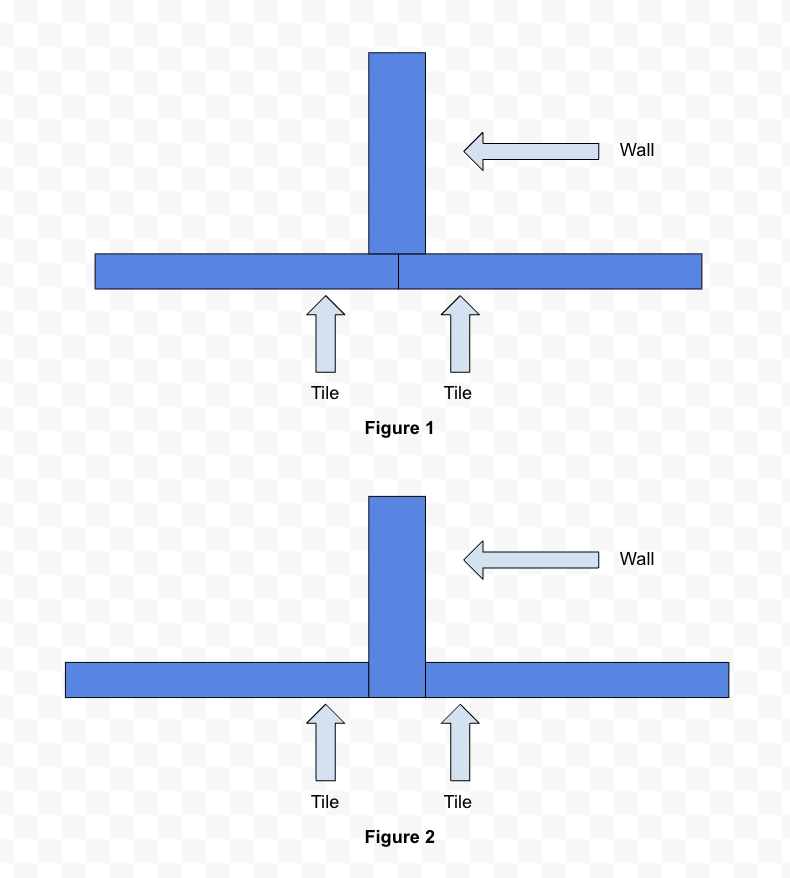
I am curious if the walls will be on top of the tiles, for example on top of the edge of the two tiles, see Figure 1, just like in Korea or will it change to have the walls sandwiched in between two tiles, see Figure 2.
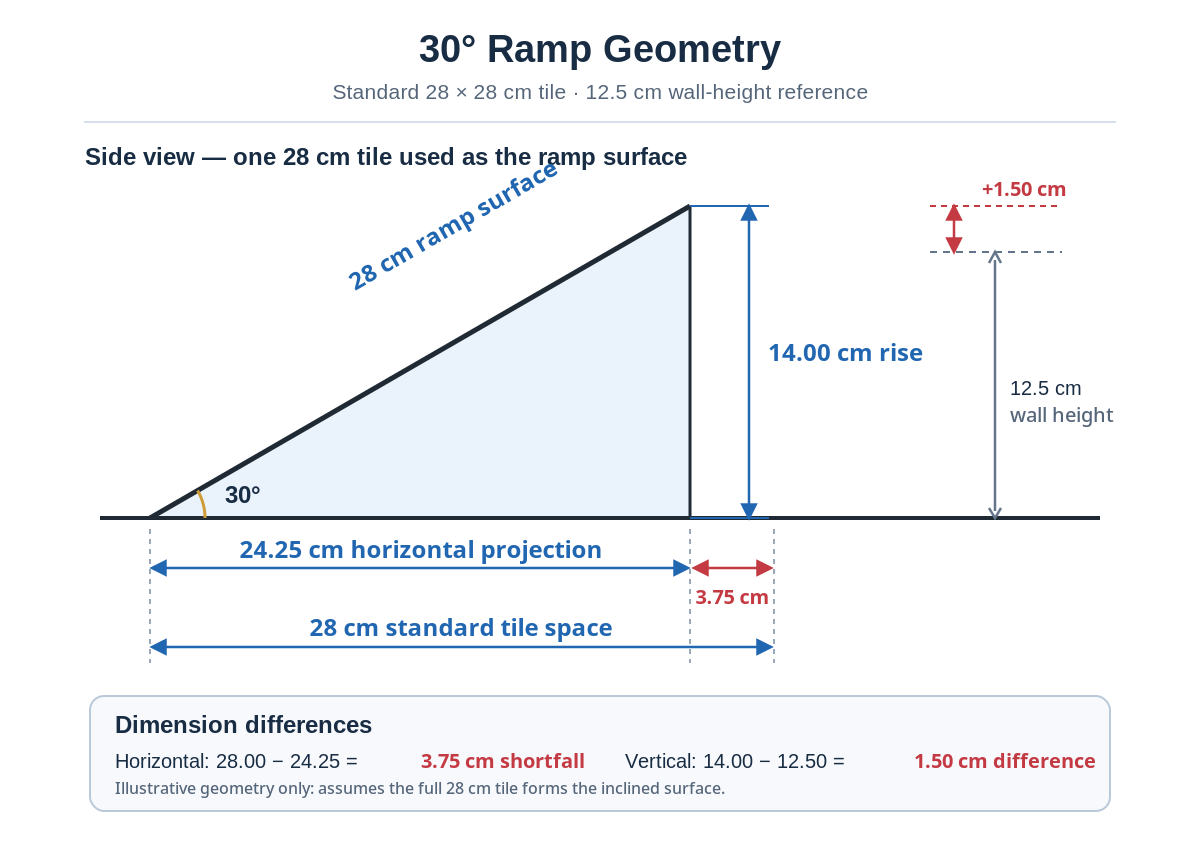
I would like to clarify how the committee intends to construct a 30° ramp using the standard 28 × 28 cm maze tiles.
As shown in the diagram, if a 28 cm tile is inclined at 30°, its horizontal projection would be approximately 24.25 cm , leaving a 3.75 cm gap within the standard 28 cm tile space. Additionally, the ramp would reach a vertical height of 14 cm , which is 1.5 cm higher than the minimum wall height of 12.5 cm.
My question is how the committee plans to accommodate these dimensional differences. Will the ramp use modified tiles, additional transition sections, or another construction method?
That’s definitely a fair point, and I agree software has a real role here. Smooth acceleration, IMU-based slope detection and careful approach control can all make a robot much more reliable on a steeper ramp, and that’s good learning.
Where I’d gently differ is that software can only make better use of the physical margins a robot has. It is certainly fair to say if the wheels don’t have enough grip for 33°, or the chassis can’t clear the crest, no algorithm will get it up the ramp. So the size limits still matter, because they decide whether those margins can exist in the first place.
And we are definitely on the same agreement that RCJ is about teaching students to overcome challenges, not removing them. My only concern is making sure the challenge is one students can meet through what they learn, both mechanical and software, rather than mainly through access to specialized hardware. I think we’re closer in view than it might seem.
About "only fixating on mechanical design”, apologize for not clarifying my point earlier. After I read my last post, I see how that came across that way. On “eliminate constraints or overcome challenges,” Again - a false choice of wording on my part! I am not asking to remove challenges.
Software can make better use of a robot’s physical margins, but it can’t create margins that aren’t thee. The “door beside the brick wall” exists, but it only opens once the hardware is inside the physical limits. That’s why the size rule matters.